

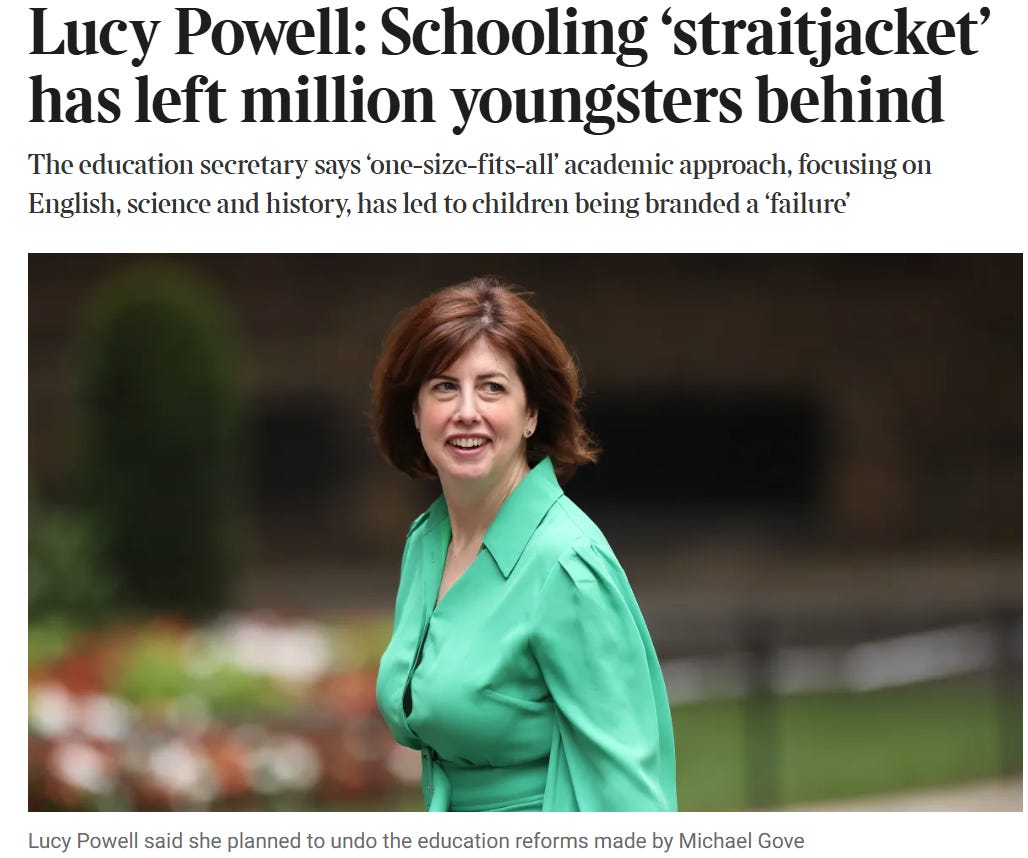
Honestly. You go away for one week and the Prime Minister announces plans to make seismic changes to secondary education in England.
As I predicted in my piece looking at what his education agenda might mean, he has moved very quickly to try and establish the MBacc principles nationally via a new focus on technical education. The narrative is right at the maximum end of what I suggested, covering the full 14-19 phase (though it appears that funding devolution to mayors will only be from 16). This has been backed up by an oped from the Secretary of State in the Times yesterday.
A lot of people I respect have commented at length on aspects of what this means – Daisy, Iain, Sam, Anthony Finkelstein, Tim, and Peter Hyman.
My view, as I said in my previous piece, is that I think making changes from 14 is a big mistake. I agree with huge chunks of what Daisy and Sam say in their substacks: all the prior evidence says selection at 14 is driven more by getting rid of difficult children than on technical aptitude; there is little evidence to believe employers will play their role at scale; and education ought to be about a broad and balanced and, yes, academic basis for (almost) all until the end of the monolithic phase, which is 16.
I also think the politics of this has been misjudged. We can have a technical argument about whether it’s right or wrong in policy terms. But to directly address Peter Hyman’s thesis - Blair wasn’t being a political ingenue when he nixed Tomlinson, nor was he running scared from a Tory party 250 seats adrift of him that they had zero chance of making up in the next election, nor was he overly worried about the Daily Mail front page which published negative articles about his govt every day. His judgement was that the A Level (and the GCSE, to a lesser extent) was a highly esteemed qualification nationally and globally and that should not be easily thrown away; that written exams were what voters knew and trusted; and that scrapping well known qualifications for new ones had a poor track record, no matter how often ministers insist the replacements are just as good. The last 20 years seem to have proven his point, rather.
So my unashamed starting point is I’m team Daisy and team Sam in terms of 14 being a mistake, and with them both (and Tim) on the correct focus being on high quality qualifications – academic qualification – for all or almost all till the age of 16.
But Peter and Iain are right that there is something in what the PM is trying to achieve that deserves consideration. So I’ve taken Laura’s challenge to advocates – what will change this time so that these reforms don’t fail like the last ones did? – and tried to come up with a good faith list of things which the government can do / should consider. I hope you all appreciate my selflessness.
Sort the problem statement out. Is government trying to improve the qualification pass rates that successive cohorts of 16 year olds get, including those who are statistically unlikely to pass a suite of almost entirely academic qualifications? Is it trying to provide better options for a technical route from 14 for anyone, including those highly academically able? Is it trying to fix labour market issues, including the increasing rate of youth unemployment?
These are all public policy issues. But they are not the same issue, they do not cover the same young people, and they therefore cannot be solved by the same policy prescription. Often times in the past, politicians have blurred the first two in particular. They talk of the importance of high end vocational skills to the future economy, and then slide in the very next sentence to people who are unable to master or disengaged with the academic curriculum. Even the narrative for the MBacc started with “the two thirds of young people in GM who don’t go to university”, and who deserve an equivalent pathway. Those first two goals I identified are not the same. This is why various reforms and new qualifications like T Levels that tried to do both have been limited in their success. Being crystal clear on what problem this reform is trying to solve is the first step to making reform work.
Utilise the existing flexibilities in the 14-16 curriculum and accountability framework more. We know now that Lucy Powell won’t reopen the Francis review – but as I’ve previously written, this is a convenient red herring for all sides to hide behind because a lot can change in the government response without unpicking the full review. One of those areas is Progress 8. The current Progress 8 framework allows for around a third of all KS4 time to be utilised in any subject – GCSE or GCSE equivalent (the “open bucket”), but most recently, DfE has consulted on widening this (contra Becky Francis’ advice), though as proposed it would actually reduce the space for “technical qualifications” to 2 of the 8 new buckets – but still, one quarter of the curriculum time.
The consultation has now finished and the new P8 measurement was due to be published last term, but has been held up, presumably because of the political manoeuvrings. This means that Lucy Powell and her team have a very powerful lever just waiting to be pulled. It will be relatively straightforward to take the changes ready to go, and amend them further if needed, such that a new system for teaching from September 2027 offers more space and accountability points for technical qualifications (GCSEs, or GCSE equivalents). Getting this right is one of the biggest and quickest changes that DfE can / will make.
Use the new V Levels at 16 and the pathways leading up to them. V levels will replace the smorgasbord of non-A Level qualifications available at Level 3 (most famously, BTECs) and have been designed to fit in the middle between A Levels and T Levels. That is to say, they will be predominantly “technical qualifications” but they will only be as “fat” as one single A Level, meaning a typical young person can take 3 or even 4 of them, or mix them with A levels, or indeed other college based qualifications as well (unlike T levels, which are 3 qualifications “fat”, meaning one T level subject is all a young person takes). There are three V Levels already approved for teaching from Sep 2027 - Accounting and Finance; Digital Systems and Data; and Education – and a further 11 at least from 2028 (Applied Research and Technology; Construction Design; Engineering Design; Engineering and Manufacturing; Health; Healthcare and Clinical Technologies; Legal Services; Leisure, Exercise and Sports; Management, Procurement and Supply Chains; Marketing and Retail; and Social Care). As part of the wider V level reforms, there are also Level 2 preparatory pathways for some would be V Level students aged 16 to 18 also being created – the Further Study pathway and Foundation Certificates, or the Occupational pathway and Occupational Certificates. For 14-16 year olds, there are a handful of existing “Tech Awards” qualifications introduced by the last Tory administration, though these are very small in number and not especially standardised, assessment wise.
Taken together. these new Level 3 qualifications, and the new Level 2 pathways, ought to do exactly what the PM wants – a terminal qualification that is 1 A level wide, based on a technical competence linked to a labour market need, and with a preparatory qual for some 16-18 to help them be ready for it. Widening what is available as a qualification subject here from 2028, and getting employers lined up behind them, would be an easy way to turbocharge the PMs plans.
[edit: thanks to 3 separate informed commenters who helped me disentangle the Level 2 preparatory V Level pathways and the age range, and the role of Tech Awards. Original text has been changed.]
Build greater school and FE collaboration. The biggest issue schools have in offering technical qualifications is space and facilities. It’s neither desirable nor feasible for schools to create labs or workshops or mocked up industrial or technological settings. But FE can, and does, have these (and has had a lot of capital funding in recent years, quietly, to upgrade them). We need to drive much grater collaboration of students across schools and FE.
Around 10,000 14-16 students a year do some FE provision, across 160 colleges – around 40% of which is some form of Alternative Provision, around 40% of which is taken by students under elective home education, and the balance via what is called direct entry – ie young people registering directly at the college and leaving school at 14 - which is much smaller, about 1500 young people a year in a dozen or fewer colleges. These types of school / FE collaboration have diminished hugely in recent years: the Wolf report landed the first blow by removing a lot of equivalent qualifications from league tables, many of which had school students at college 1 day a week; and Progress 8 did the rest by making the sending institution – ie the school – responsible for the outcomes of the student even if they’re studying in college, because they are still deemed to be owned by the school.
There’s a lot in both the Wolf reforms and the P8 reforms which is highly sensible and I’d be loath to create a whole new set of equivalencies, or lose the school responsibility for students, which prevents them dumping difficult or low attaining kids on colleges. But there would surely be something possible in terms of creating new jointly owned qualifications, or joint registration of some students. It would need to grapple with questions of funding and accountability metrics, but this is the only way to make these pathways viable for lots of young people by giving them access to top class facilities.
Be clear on what line of sight to the labour market means, and where it is helpful and where it is limiting. I’m really torn on this one. Part of me entirely agrees with the PM, and reports like the White Working Class Inquiry, when they talk about the importance of place, and localism, and not needing to leave where you grew up in order to get on. In other words, shouldn’t we have a better offer for Oldham kids than “have you thought about moving to Manchester or Leeds or London?” Set against that, I also think that if education stands for anything, it should be emancipatory, and it should offer all young people the opportunity to go as far as their horizons take them. In other words, shouldn’t we also have a better offer for Oldham kids than “where do you see yourself working in the future Oldham jobs market?”
The way I reconcile this in my head is that young people should have a greater understanding of what their local area looks like. A lot of work has been done on the measurement side, and LAs and Mayors are bulging with new LSIP plans and labour market models and Skills England projections. But all the qualitative work we have done with young people suggests this isn’t really landing. I think “line of sight” is much more likely to be impactful in areas of large population density, and / or dominant industries. I do think it’s helpful for Oldham young people to know where Oldham and Greater Manchester is growing. But in smaller towns, and areas with a more mixed labour market, this is probably less useful. As my learned colleagues said, “what does a locally-designed curriculum offer in a coastal town or a rural county mean where three main employers dominate and one of them is the local council? In those places, aligning provision with local demand risks narrowing options rather than expanding them”. Government should focus on making line of sight a reality for curriculum design and careers advice only in larger conurbations, rather than demanding it for all schools and all geographies.
Utilise the Careers and Enterprise Company retendering to put more focus on school aged technical information and careers advice. DfE have already announced that they’re shortly to go out to market with a renewed national offer for careers support for young people, going live from 2027. Public procurement in general is an underrated way of government delivering its objectives. If I was in DfE now, I’d want to design this tender in a way which directly brings together the labour market information above, and offers greater focus on technical curriculum and qualification pathways for 14-16 year olds, as well as more traditional careers advice. They can more or less guarantee that the CEC itself, if the incumbent wins, or the new successful bidder(s), will rapidly agree to pretty much any contractual terms here.
Change Ofsted (again). This has been more or less sketched out in the government announcement, given the huge power that an Ofsted framework has in driving school and college behaviour. Changes could include more prominence for the “Baker clause” requiring schools to give training providers and colleges access to their students to discuss apprenticeships and technical routes, and / or changes could be made to the curriculum and teaching area, or leadership and governance, to emphasise the importance of a secondary school offering a broad and balanced pathway, including full consideration of technical routes from 14 on. This shouldn’t be rushed – it’s probably 12 to 18 months of careful reform – but it’s a major lever.
Strengthen and amend mandatory work experience (and the associated Gatsby benchmarks). From September, schools will need to offer a week’s total of work experience and engagement to students across Years 7 to 9 and a placement lasting in total a week across Years 10 to 11- two weeks in total. This was a manifesto commitment.
The DfE has now published statutory guidance on how it should work – a very long document with lots of “you musts” in. This is therefore a very easy lever to pull if you want to make it more specific. For example, benchmark 2 currently says that schools must offer information on “a diverse range of progression pathways, including technical routes, to strengthen the capacity of learners to make effective choices and transitions”. That could be strengthened to be much more specific on what routes, and how such information would be accessed. Similarly, benchmark 5 currently says “every year, from the age of 11, pupils should participate in at least one meaningful encounter with an employer” and that this should particularly focus on the IS-8 sectors. This could change to say that there should be two meaningful encounters, one of which must be a technical employer / an employer that hires people into technical roles (and hence dive into a world of difficulty in defining these terms – but hey, it wasn’t my announcement).
Utilise the “Year 14” option for some students doing Level 3 qualifications. This is something UCAS have been pushing, based on their visibility of a lot of this cohort. 16-19 funding is built around age, not years in state funded education. Funding rules for 16 to 19 entitle a student to funded study through to the end of the academic year in which they turn 19. So a student who needs three years, rather than two, to complete their Level 3 programme; whether due to resits, an extra qualification, or additional support needs, remains eligible for funding in that third year, provided they haven’t already completed their qualification (and that a college will take them for the additional year).
In other words, the system could use the flexibilities within this existing approach to “catch” students who leave school or college either with a qualification they didn’t want, or that they didn’t do well in, or to help them switch half way through 16-19 from an academic qualification to a technical one (or vice versa). This lever acts far more on my original objective 3 (solve the labour market issue) than objectives 1 or 2 (catch disengaged young people at 14, and / or boost high quality technical education), but amplifying the ability and willingness of colleges to offer this additional year – with appropriate funding - could be an important part of the picture in providing an easier switch of young people in the 16-19 phase, and prevent the default opt to academic qualifications because they keep options open better.
Keep GCSE resits. A small but vitally important reform – which is, don’t reform in this area. Regardless of what pathway students choose, or wherever they want to work in the country, the single best protective factor they have against being NEET and the key that opens the most doors, is a GCSE in English and a GCSE in maths – and wherever possible a GCSE, not an equivalent qualification. Getting a C above a D (in old money) has been shown to boost future participation in education, and the CAR shows how possession of GCSEs correlates positively with earnings, employment, health, life satisfaction, and civic engagement.
An oddity of current educational debate is that people will argue convincingly that the resits policy is unsuccessful, despite pass rates having risen consistently from the policy’s introduction in 2014 through to the pandemic (see figure 2 here) and where, crucially, the outcomes for disadvantaged students have improved faster than for their advantaged peers. As Andrew Otty, the author, summarises in his piece for the Social Mobility Commission, “the 16–19 resit sector is the only stage where disadvantaged learners are actively catching up to their peers…..in the decade since its introduction, over 500,000 students have successfully retaken English and over 350,000 have done so in maths. Crucially, more than 245,000 of these passing grades were achieved by students from disadvantaged backgrounds.” Given the Secretary of State’s new Spad, Sarah Waite, is a fierce and passionate advocate for resits, and whose charity Get Further has done magnificent work in the 16-19 resit space, I hold hope that this hand-wavey “oh let them give GCSE maths up, it’s *hard* for them” line of argument will be given short shrift.
So that’s it – a 10 point plan for reform. As the joke goes, I wouldn’t start from here, and there’s a lot I’ve written above that I’m sceptical about – but this is a coherent way through of making the commitments work.
The “line of sight” point really resonates. I think young people need much better visibility of what work actually looks like in their local area, but also enough information to understand that their choices don’t have to be constrained by it. The same applies to technical routes — if schools explain university in detail but only mention apprenticeships in passing, it’s hard to describe the eventual choice as fully informed. Better careers advice and meaningful employer exposure seem crucial here.
This is a great summary of where the announcement of 14-19 change leaves us. The idea of using existing levers and pulling those to make things change quickly and with minimal impact on how schools and colleges already work is definitely the best approach. There are two key things for me that are most important to mention.
First, is keeping schools accountable for any study pupils do at colleges. I don't think this is an issue with the right quality assurance in place and across schools and FE I feel it works best if the home institution is held to account here. It would also mean schools had to better understand how colleges work rather than just passing pupils on.
Second, your idea of using Year 14 more is spot on. Many young people in post-16 want to change but face barriers due to the funding rules and regulations in this area and easing and simplifying it so there was a clear entitlement to three years of post-16 education would be great. The DfE also needs to get rid of the funding drop for 18 year-olds, i.e. Year 14s, where currently there is a huge disincentive to keep young people for a third year.
Keep up the good work Jonathan - your commentary and observations are always good to read.