

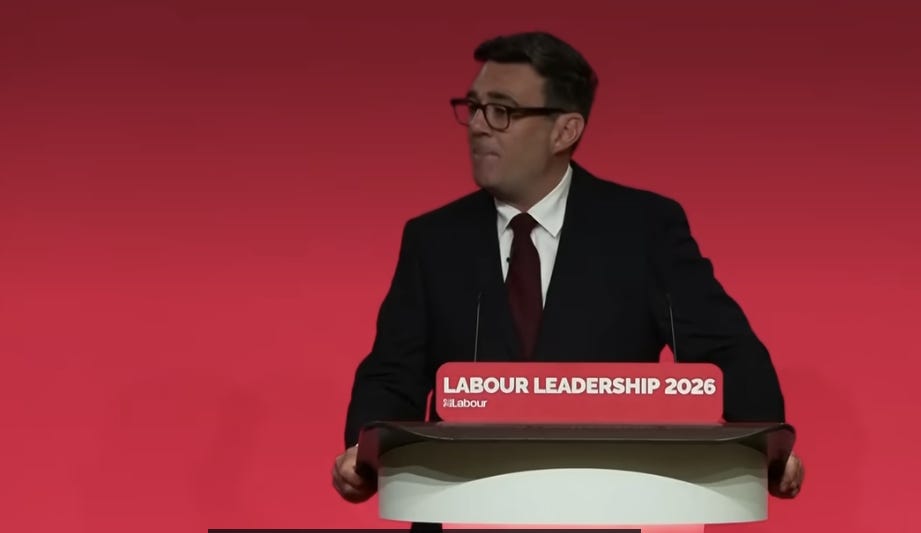
Our new PM gave his first speech as Labour leader on Friday. And I didn’t like it.
Specifically, I didn’t like the backwards looking framing of it.
I have always disliked the “40 years of decline” narrative that he has espoused. It didn’t matter so much when he was Mayor of GM – not least a lot of his actions, including the work he did on service regeneration and with and through universities, were pretty modern and forward looking – but it matters now he is going to be the PM, not least the framing of what you say first as leader and PM-in-waiting is pretty significant, and therefore pretty indicative of your philosophy.
On Friday, Burnham said this:
I want people to understand the thinking behind the political direction I set so people can see the decisions we take and the reasons why.
I am clear: Britain took a series of wrong-turns in the 1980s.
Political power was centralised and economic power was privatised.
The country surrendered control of the essentials – housing, water, energy, transport – and left people exposed to higher costs.
That, in turn, led to the concentration of more wealth and power in the hands of fewer people and fewer places.
Large parts of Britain were deindustrialised without the power to set new ambitions for themselves.
Proud British towns now a shadow of what they once were and high streets in decline, so common up and down the country.
He then goes on to show how Liverpool exemplifies the decline:
Political power was used viciously against them to protect vested interests.
Economic power cruelly stripped with the deindustrialisation of the 1980s, as it was against so many places up and down the land.
And let us never forget: these are the very same places that built this Labour movement, this Trade Union movement where we are today. Those are the places but they were the places that were done down.
This Labour movement, the Trade Union movement, was forged in the steel works and iron works of Sheffield, Scunthorpe, Port Talbot and Teesside.
In the coalfields of South Wales, Central Scotland, Nottinghamshire, Derbyshire, Yorkshire and Lancashire.
In the mills across the Pennines, west and east.
In the shipyards on the Clyde and the Tyne.
And in the dockyards of Liverpool and here in London.
The people of these proud places made Labour.
Now there is something in this, to be clear. As someone who is half from Liverpool (and the other half being Californian Jews – yes, holidays and family reunions are wild round at the Simonses), I’m not going to defend how the city was treated under the Thatcher administration in particular.
But I passionately dislike this narrative from a Prime Minister in 2026, for four reasons.
Firstly, the 40 year critique is contestable. Let’s dive into the Liverpool exemplification a little more.
Liverpool in the 80s was in many ways a wreck – economically, culturally, socially. But it is both true that the Thatcher administration made a series of (often quite seismic, and often quite deliberate / uncaring) missteps, and that the working class Labour that Andy Burnham loves also made some huge errors, and that much of this was shaped in the 60s or even earlier, and that actually the last 40 years under both Labour and the Conservatives has transformed Liverpool for the better.
1986 places us just after the Militant budget in 1985, and the famous Kinnock speech later that year decrying a Labour council sending a fleet of black taxis scuttling around the city handing out redundancy notices. And yes, the Thatcher administration was hostile to the city (though Heseltine in particular genuinely tried to address its economic obsolescence).
But the docks didn’t decline and the city fall into trouble because Thatcher willed it. They declined because global shipping moved to containerisation in the 1960s, which favoured deep-water ports on the east and south coasts over a city built for an Atlantic and imperial trade underpinned by mass labour from across the Empire that no longer existed. Manufacturing in the city was already shrinking through the 1970s, well before anyone had heard of monetarism. And some of the worst planning decisions, like slum clearances leading to the isolation of entire communities in new estates like Speke and Kirkby with no transport links back to jobs and services, were made by Labour councils in the 1930s through to the 1960s that sought to privilege (white) male employment in historic industries over lighter industrial work and the growing labour force of women, not Conservative councils in the 1980s.
And as someone who has gone back to Liverpool and family regularly since 1986, including the Anfield area of the city, I have watched the whole place transformed in the last 40 years, almost all for the better. Liverpool of 1986 was boarded up houses in terraced streets all around Anfield. I used to be pretty scared as a kid walking to Liverpool games with my uncle and grandad. There’s still some of that now, but a lot less. I happily park my car and take my daughter. The docks don’t hum with ships anymore, but they hum with commerce and tourism. The city centre is still Victorian magnificence, but modernised (including with a lot of EU money). Yes, there’s still poverty, inequality, and unemployment. The city centre regeneration hasn’t always spread to the outskirts of the city. It has fallen well behind Manchester as a point of comparison. But my guess is that the average person my age or younger, living in Liverpool now, doesn’t think that the last 40 years has been one of non stop decline for the region.
Which brings me to my second reasons for disliking it, which is the politics. Patrick Maguire wrote a fascinating column in Friday’s Times in which he sketched out something of Burnham’s philosophy. In his narrative, Burnham is less from the “soft left” and more from the “old left”, which in Maguire’s words “is born of the trade union movement and its parliamentary supporters”. This wing’s critique of Miliband is that the latter is from what Maguire calls the “London left” which is “all about renters in flatshares or people who commute to work by train. Net Zero, liberalism on immigration, et cetera.”
This philosophy is very much of a piece with how Burnham critiques the decline of Liverpool since the 1980s. Sam Wetherall, who comes explicitly from the Left and wrote the magnificent “Liverpool and the Unmaking of Britain”, explains that much of the 20th century history of Liverpool’s Labour, including Militant, has been the dominance of the Old Left. White, male, working class labour was what was privileged throughout the century – in everything from council house allocation, to the management of dock jobs as shipping declined, to the growth of wider city services, to how slum clearances mostly affected Liverpool’s historic minority communities (many of whom came into the city during the mass imperial shipping period that was its zenith).
As Wetherall says, “the legacy of Militant is tarnished not by its belligerent tactics, but rather because it had little interest in the ways that Liverpool’s society had actually been shaped by the city’s imperial history”. Liverpool Militant Labour, and Labour more generally in Liverpool in the 1970s and 1980s, was uninterested in parallel movements of the Left in London, or Sheffield, which were much more encompassing of radical feminist or black movements, for example. Were Militant around today, you would imagine that they too would be sceptical about renters in flatshares or people who commute to work by train.
I’m not calling Burnham Militant, to be clear! Indeed, it’s interesting that two of the people he named his political heroes and who were present at his speech were David Blunkett (the 1980s leader of Sheffield council, espousing a much more rounded version of leftism in cities), and Neil Kinnock (baiter and hater and later the dispatcher of Militant). But I am saying that this easy, reflexive tilt back to the left being about class, and steel mills and coalfields and shipyards and dockyards, and Northern men in Northern towns, is politically weird in 2026. As Stephen Bush repeatedly and wearily says:

To be a voter in Liverpool, or Sheffield, or Leeds, or Scunthorpe or Teesside or the Clyde or Makerfield, or anywhere now, and to remember and to have been shaped by the fights over Militant, and more widely the decline of male working class labour, you would need to comfortably be in your mid 50s and most likely a decade or more older. As I say above, I just don’t think this paean to industrialisation speaks to many people my age or less.
This is not the future of our country, it is not the challenge that the modern working class in those towns and cities face and I disagree with a philosophy that is shaped by it.
The third reason that I don’t like it, is that to the extent that there is something in the critique of the failure of the 1980s and 1990s revolution to lift all boats, and for centralisation to have been a lot better for London than Liverpool, it is not new.
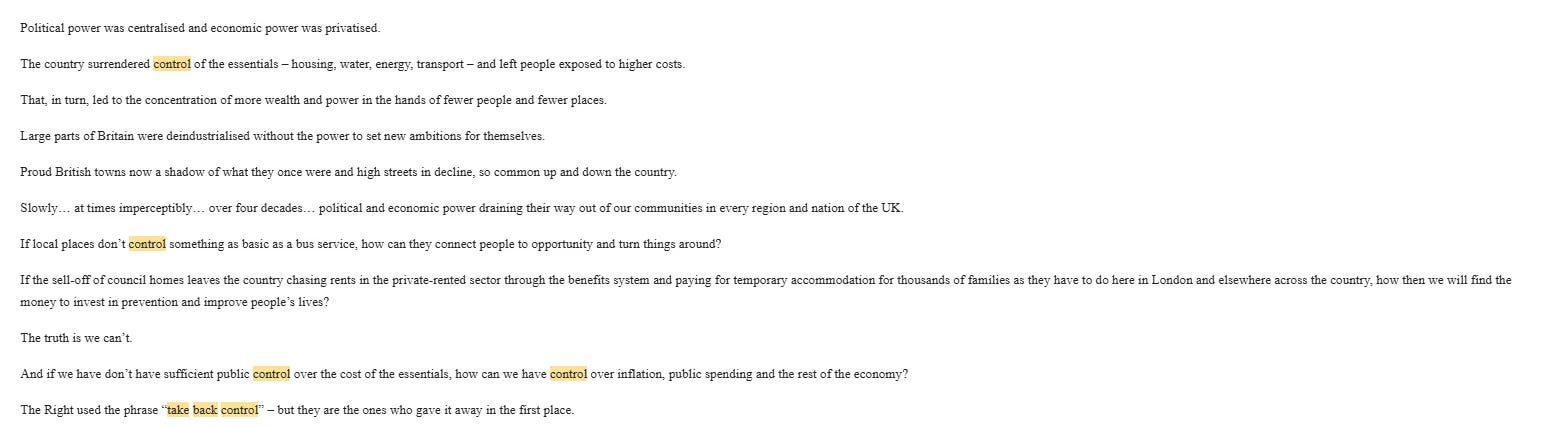
In 2023, Keir Starmer said this:
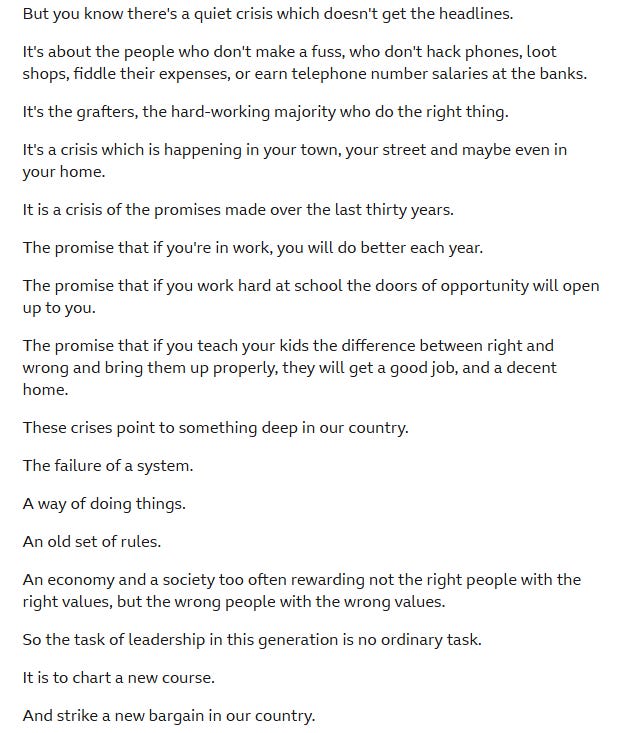
In 2011, in the famous predators versus producers speech, Ed Miliband said:
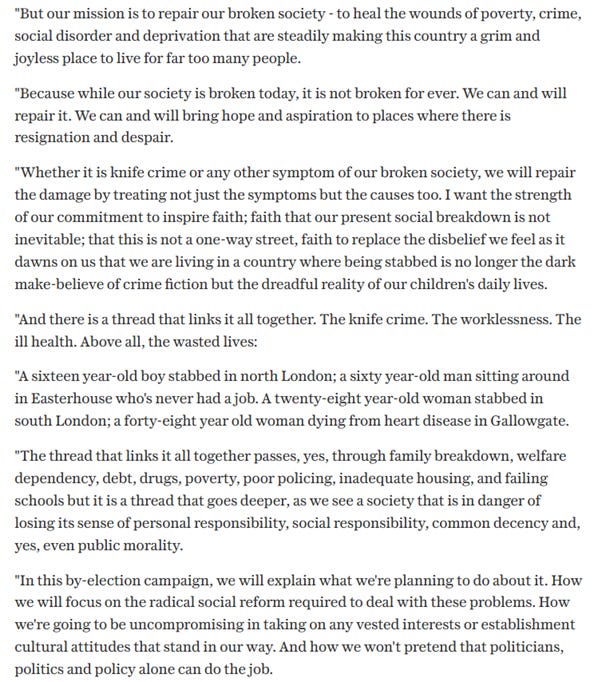
And even David Cameron, in 2008, said
As Matthew Holehouse of the Economist notes in his highlighting of the Starmer speech, “the calling of time on the Thatcher/Blair pro-globalisation consensus has been done for quite a long time now”.
And the fourth and related reason I don’t like it is that it isn’t clear what the policy prescriptions are that flow from it in 2026.
I didn’t expect Burnham to come up with a laundry list of things in his speech on Friday. He’ll probably do some more detail in No10 on Monday.
But what we do seem to know – appointing Shabana Mahmood as Chancellor with a remit to cut migration further, with almost certain economic harm; scrapping or cutting back DSIT; focussing on the growth of North Sea oil and gas – says to me that this is someone whose policy prescriptions were shaped in the industrial battles of 40 years ago or more, and who does not understand, or does not believe, the challenges facing our country and the Labour voters in the 2024 coalition:
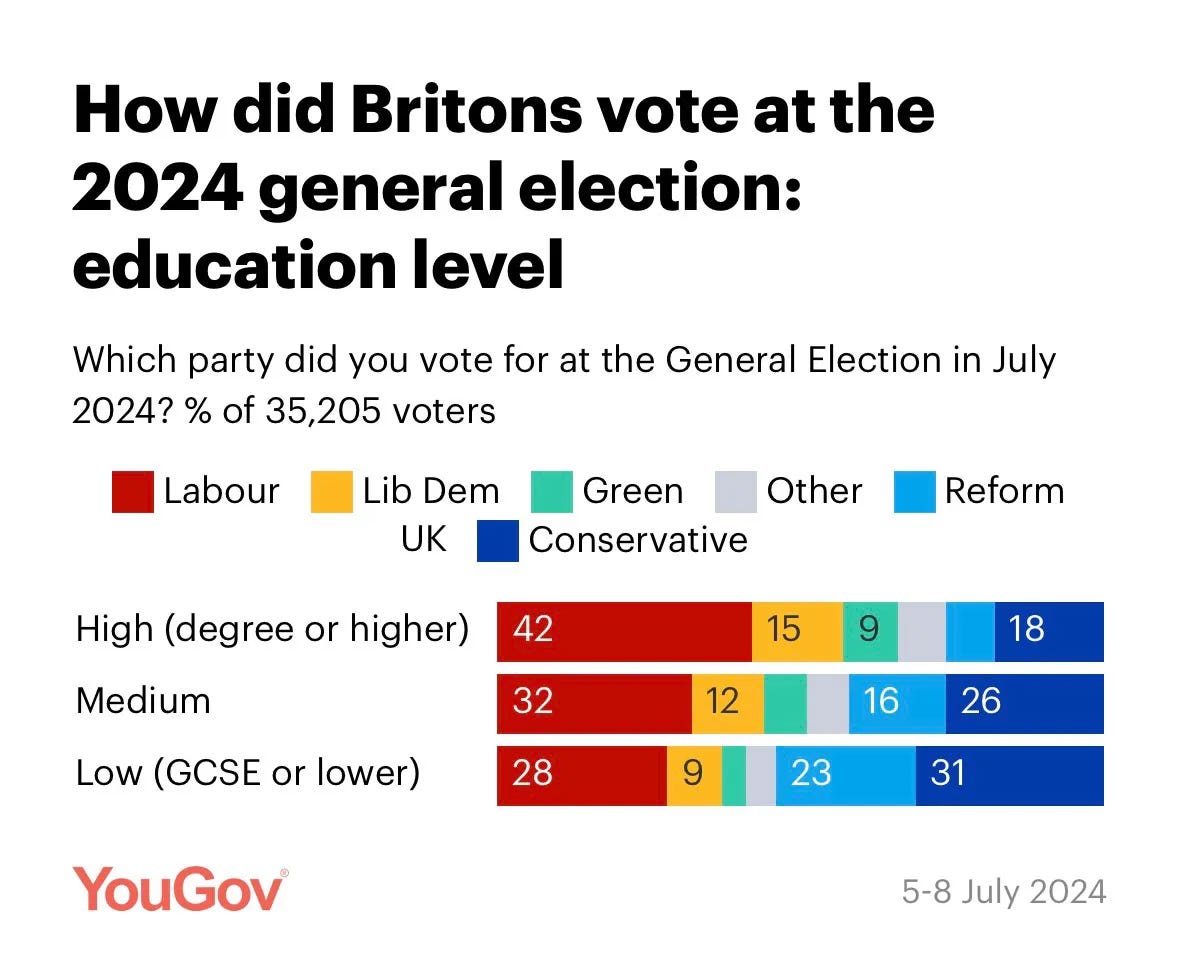
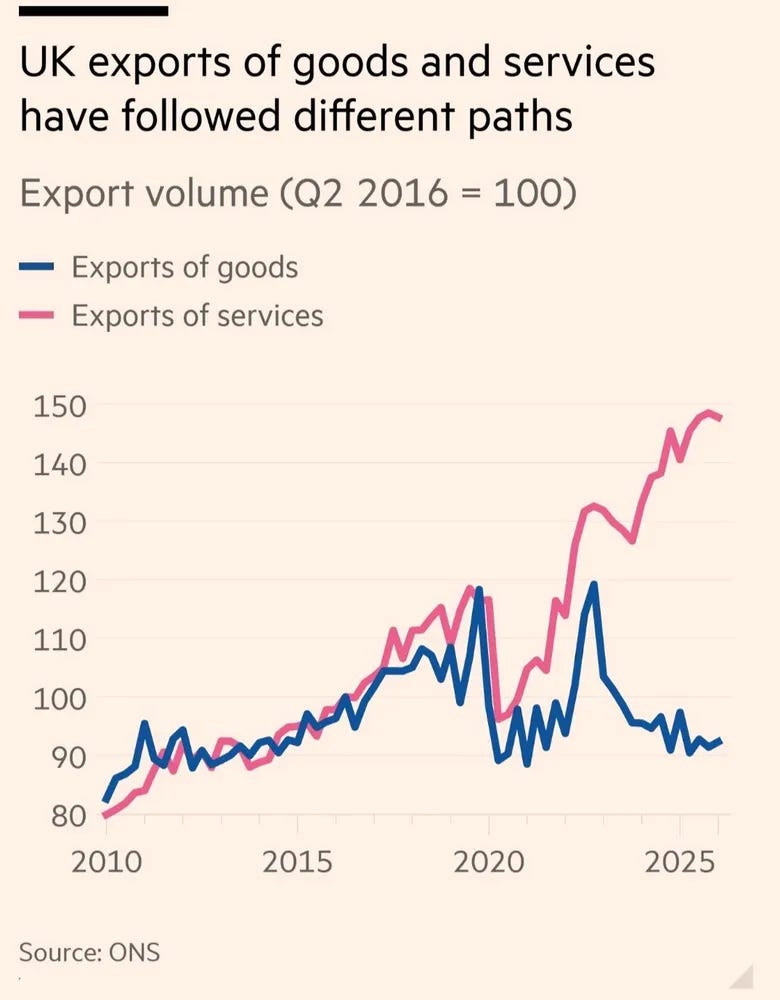
The risk is that Labour have picked a leader who communicates well, but whose instincts are wrong.
It’s certainly true that two years of technocratic drift under Starmer didn’t land with Labour MPs or voters; maybe they wanted conviction, and nostalgia is the conviction that was on offer.
But although Burnham's centralisation critique may well have real force, his speech on Friday dressed up debatable history as sharp and novel insight. Most worryingly, a Prime Minister who reaches for gasfields and dockyards every time he needs to frame his vision may keep reaching for them when the actual questions for Labour voters are actually much more those posed by renters in flatshares: challenges of changing jobs in today’s labour market; challenges of growing a service economy; challenges around modern transport and energy and education; and challenges around society and integration. That’s the story that needs to be told - and it’s one from 2026, not one from 1986.
Well put. I’m constantly in awe of how little Labour MPs seem to understand the voting block that put them into No 10. It’s middle class doctors and lawyers, not a bunch of imaginary shipworks up in Liverpool. It was ABC1s who were sick of the Conservative’s harmful EU policies and dreary culture war nonsense. These people want to be able to move to better jobs without paying 1.5 years worth of income in stamp duty, be able to afford childcare, and install double glazing without having to pay the council £2.5k for planning permission.
You are writing about the history, but Burnham’s speech is focused on a ‘narrative’ to warm the hearts of some segments of LAB base. All parties need rewind time-machine narratives, it seems, as no politician is able to evoke a heart-warming future that will stir voters.
Techno-boosterism no longer inspires hope in the mass of voters , Sunak/AI most recently. Tech is frightening so let’s ban things, even if the evidence isn’t strong that it will help. People will feel that their most valuable asset is being protected.
These trends aren’t confined to Britain either. Look at France where ‘The Thirty Glorious Years’ of reconstruction and modernisation are still talked about.I believe that they transmitted this nostalgia to their children, my generation.
I got a stiff dose of how everybody pulled together during the war as a boy, and how life was classier in all senses of the word before the war. UK boomers are still obsessed with WW2 thanks to all those old war films. Nostalgia is the therefore heritable.
Sandbrook’s books show that industrial Britain lost markets as soon as colonies could buy elsewhere and that the adjustment coloured the fifties and sixties. The period is slipping from living memory so how easy to blame all on Mrs Thatcher. It now represents a safe haven for appeals to nostalgia as few remember or lives through it.
This was meant to be a short and snappy response. It’s Sunday afternoon and I no longer read the British Sunday press.